
Embraced In Every Economic System (Except This One)
Transformations brought about by AI make us forget that we're still living under scarcity

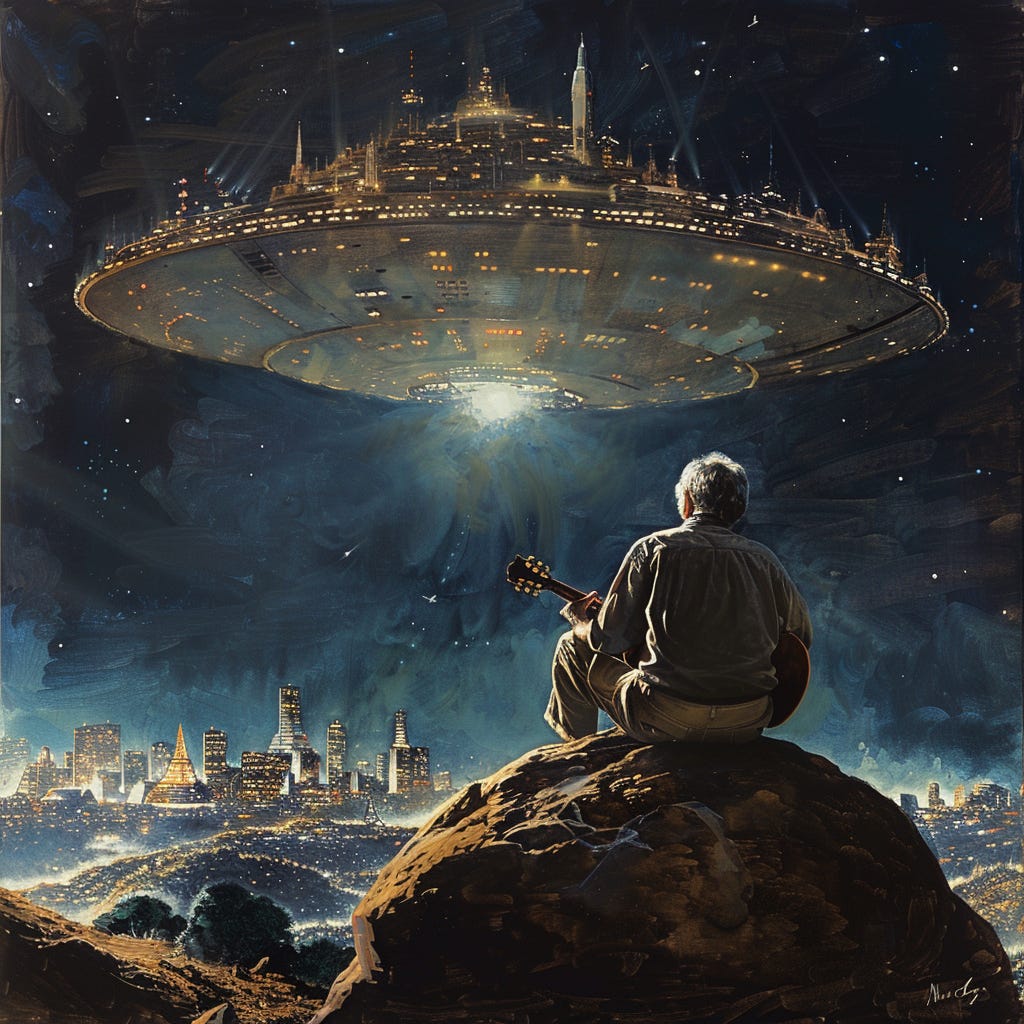
Midjourney prompt: a middle-aged man holding an acoustic guitar and sitting on a large rock looks toward a city-sized spaceship in the nighttime sky with a look of skepticism on his face. Do this in the style of Norman Rockwell.
“Large Language Models, machine learning and AI would be embraced wholeheartedly for the common good in any economic system that’s not this one.” – Me, a few weeks ago.
There is the foundational shock felt by creative people as their very purpose comes under assault, which we discussed last time. And then there is the notion that the impact of AI extends to the ways in which we make a living.
When we assess the societal impact of generative AI on creativity, it’s easy to fall back on how creativity has imagined that impact through some of its work. Indeed, invoking SkyNet from the Terminator franchise leads a lot of us to think that AI, put in a position to destroy humanity, would inevitably see us as a threat and carry out our destruction.
Science fiction, though, has just as many optimistic views of humanity and AI peacefully co-existing. Take Star Trek, for instance. Or the Culture novels by Iain M. Banks. Both show AI assuming the heavy-lifting duties for human society, without wanting to murder us all and with humanity coping with the notion that they’re not the sole keepers of imaginative solutions to problems anymore.
In both universes, humanity can take its mind off the day-to-day grindwork and instead concentrate on personal development, hobbies, and other interests. Although Star Trek and The Culture seemingly take opposite views on their technological advancements – The Culture feels obligated to share their tech with anyone who wants it, while Starfleet tends to follow that pesky Prime Directive that lets civilizations advance on their own until they can travel faster than light – but the thing we forget is that both universes are predicated on the notion that humanity has progressed past scarcity.
That is, the Star Trek universe fundamentally changed once it discovered that matter and energy are interchangeable and that they could basically create things like food out of thin air. In fact, there’s a rather funny exchange in Star Trek: First Contact when Captain Picard needs to fill in a pre-First Contact Lily about his society not having money.
Similarly, The Culture’s city-sized ships – run by AI – are able to effectively eliminate scarcity by mining asteroids and are able to vault humankind (and all other peoples) into a world where people mostly focus on personal goals and development. With AI handling society’s basic means of production, people are free to pursue any interest they like, though they may experience existential turmoil when confronted with the fact that AI can do almost anything better than they can.
As we fantasize about such a future here on Earth in 2024, we often forget that to pursue a life of exploration among the stars, there’s that pesky bit about scarcity. Regardless of where AI takes us, we still do need to figure out how to move past the notion that rare elements we need to construct our technology-fueled future are increasingly scarce and we will probably have a deficit of super-important minerals like lithium, cobalt and neodymium in the near future.
Maybe AI focuses on helping us figure out how to solve for these shortages, or any number of the threats to our physical environment that could end us before we get there.
Instead, AI is focused by its early adopter fringe on all the wrong things. I saw it succinctly stated in a social media post a couple days ago. I’m paraphrasing:
I want AI to do the dishes and the wash, so I can focus on art. But AI wants to focus on art so I can spend more time on the dishes and the wash.
Maybe this is a bit off. After all, what a lot of people call AI are really just Large Language Models and other tech that’s more easily focused on content creation than it is on solving problems in the physical world. But the sentiment has captured the essence of the situation rather elegantly.
At the core of the issue is this: Our economic and political systems can’t handle true AI yet, and that’s because we’re more apt to fight over who controls the AI while we focus it on devaluing the sense of purpose of our fellow humans.
So, I now call your attention back to the quote that opens this article. As you’re using OpenAI to roll your own GPT, ruminate on this notion of LLMs and machine learning being embraced in every economic system but the one we live under today.
Big fan of the Culture, which got me to think seriously about scarcity economics. The thing with AI is that it’s built within a scarcity framework, and thus far, as a technologies go, it is about as resource-intensive to operate as cryptocurrency mining. Which is to say, it’s not sustainable at all. Beyond that, I read today that Amazon’s AI-driven no-checkout store prototype is, in fact, just a bunch of camera feeds sent over to India where a ton of low-wage employees add up your purchases you make sure you’re not stealing. WIRED said that 2024 might be the year of AI disappointment. As long as AI stands for “Actually, India,” I suspect they’ll be proven right.